
Somewhere in a specification library near you is a wetpour clause that has been quietly serving every project for years. It was written for a playground — nobody remembers which — and since then it has surfaced toddler areas, destination parks, MUGAs and splashpads without anyone changing much beyond the colours.
It's an understandable habit. It's also how good materials end up in failed surfaces, because those four applications are not the same job with different graphics. They're different engineering problems.
Same clause, different worlds
Consider what the surface is actually asked to do in each case:
| Application | What the surface really faces |
|---|---|
| Local toddler play area | Light, distributed loading; safety-critical falls; long quiet periods; judged mainly on colour and cleanliness |
| Destination / high-volume play | Hundreds of children a day, all season; concentrated wear paths under popular equipment; loading many times that of local play |
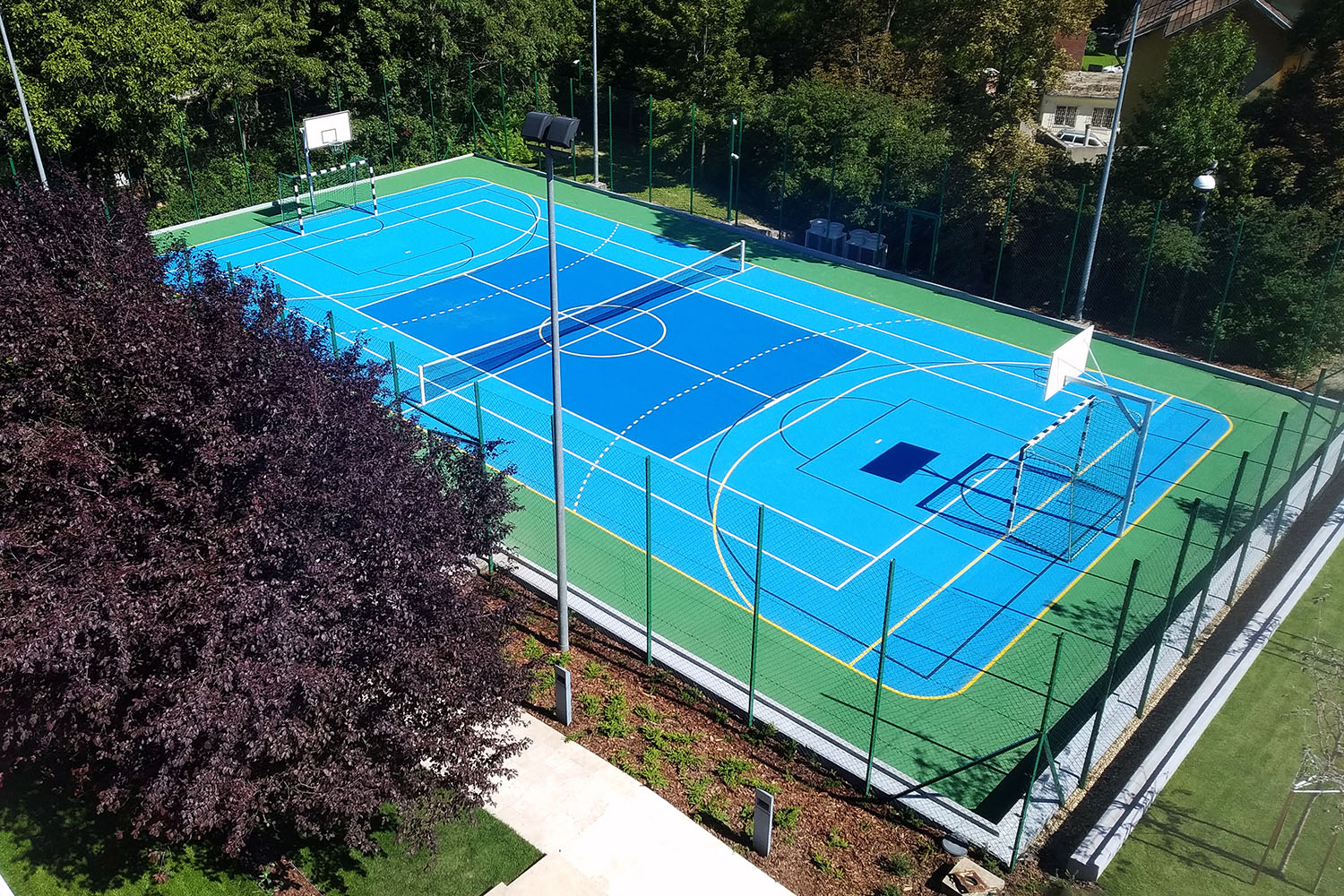
| MUGA / sports overlay | Adult loads, studded and hard footwear, ball sports; abrasion and point loading; consistency of response matters for play quality |
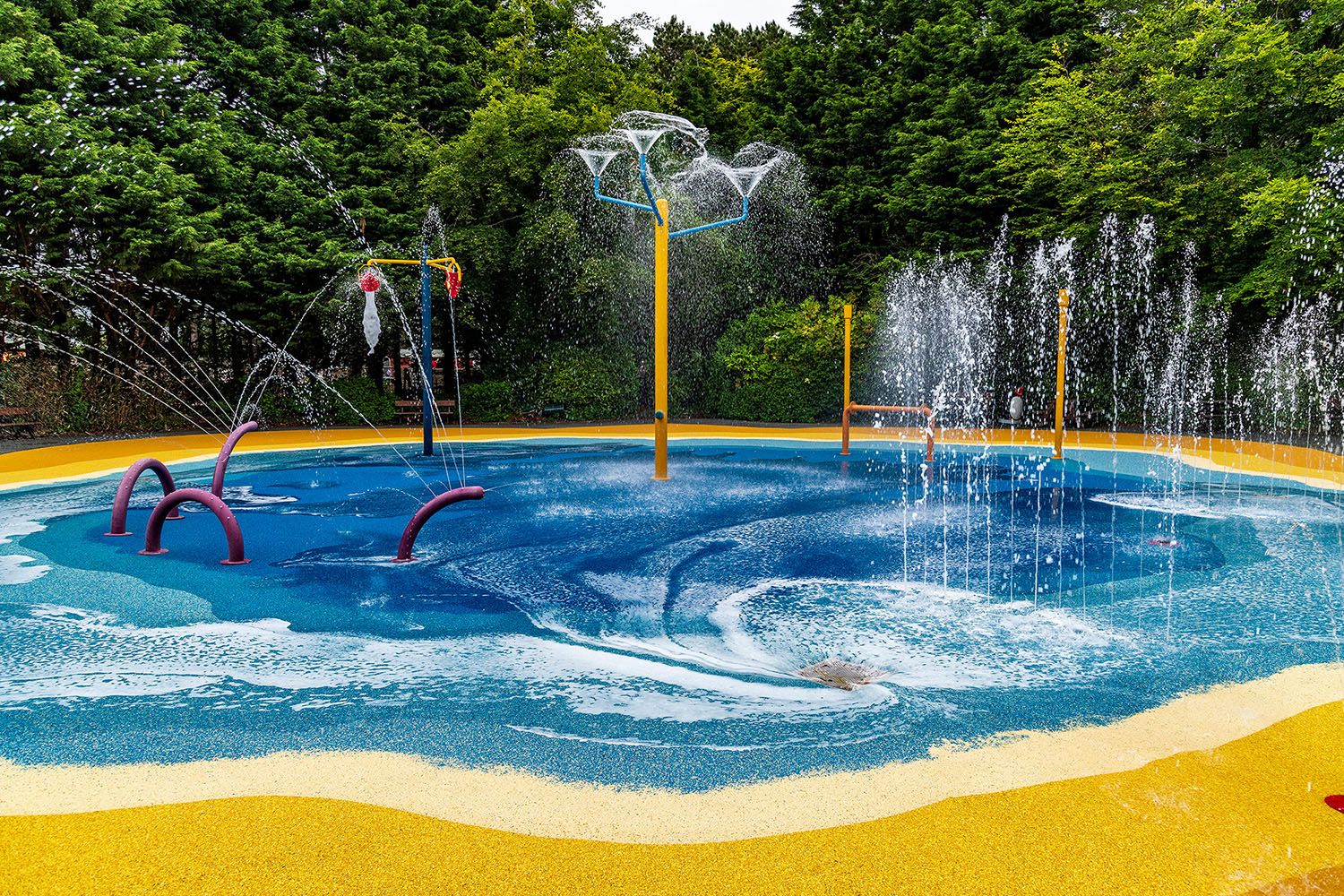
| Splashpad | Continuously wet; chlorinated or treated water; barefoot users; hygiene and drainage; wet–dry cycling all season |
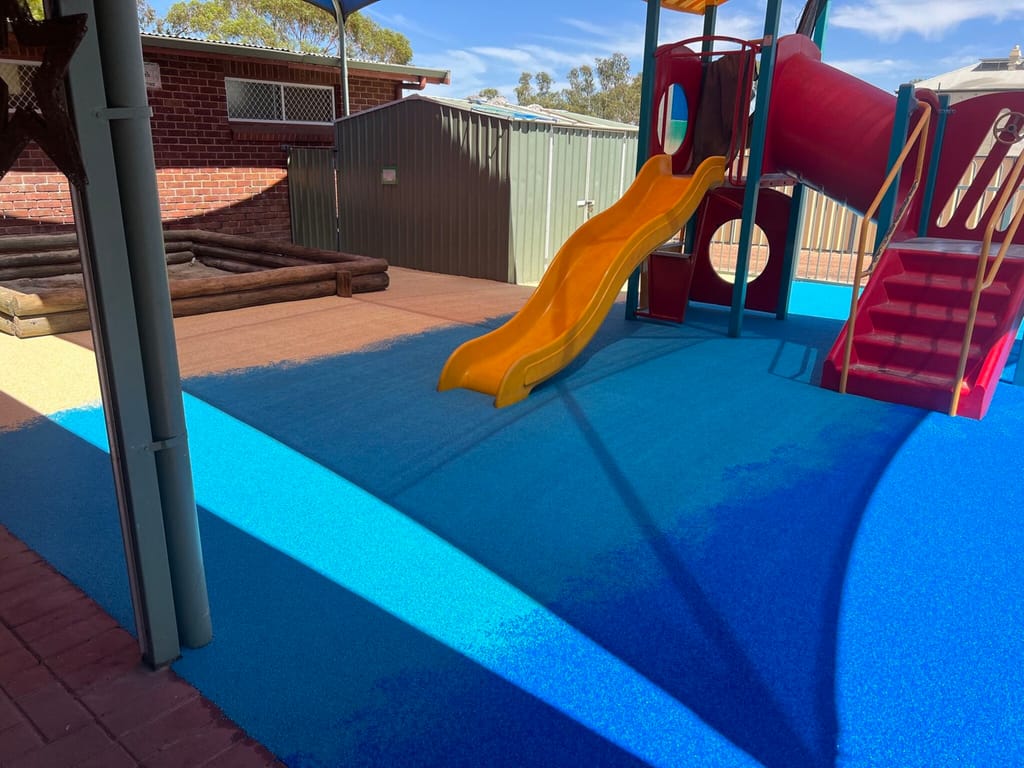
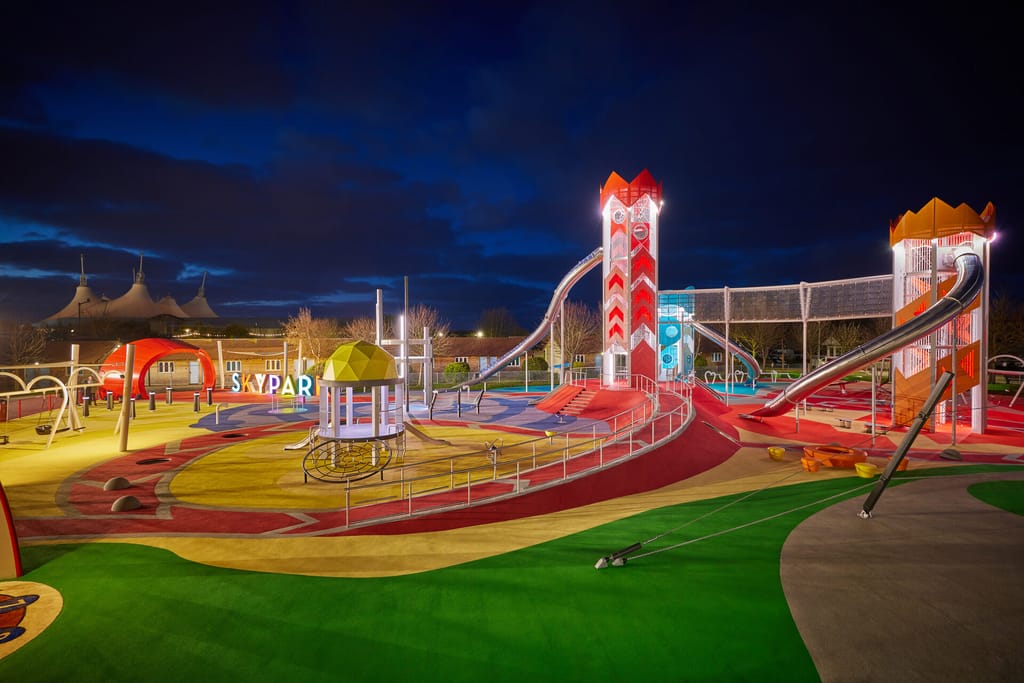
No single specification suits all four. A build-up generous enough for the destination playground is over-specified for the toddler area; a system that's ideal beside a bench will be worn through on the sprint line of a MUGA; and nothing that ignores continuous wetting belongs anywhere near a splashpad. A specification optimised for no particular use is, in practice, optimised for none.
Application first, ingredients second
The remedy isn't complexity — it's order. Define the application before choosing any ingredient, because the application drives every downstream decision: thickness, granule geometry, binder type and ratio, testing regime, and maintenance expectations. Six questions do most of the work:
- Who uses it, and how many? Age groups, footfall, seasonality, peak loading. A hundred users a day and a thousand are different surfaces.
- What does it need to protect? Critical fall heights by zone (EN 1177 belongs to specific locations under specific equipment, not vaguely to the site).
- What's the exposure? Sun, shade, temperature range, rain, standing or treated water, salt air. Environment sets the ageing clock.
- What wears it? Feet, wheels, studs, machinery, concentrated desire lines under swings and slide exits.
- What's the design life — honestly? If the asset plan says fifteen years, the specification should say things a fifteen-year surface can prove.
- What happens after handover? Cleaning, inspection, and who owns the surface's condition in year five.
Write the answers down and the specification largely writes itself — and, just as usefully, the answers expose which off-the-shelf clause doesn't fit.
What changes between applications
With the application profile in hand, the system variables stop being defaults and start being decisions:
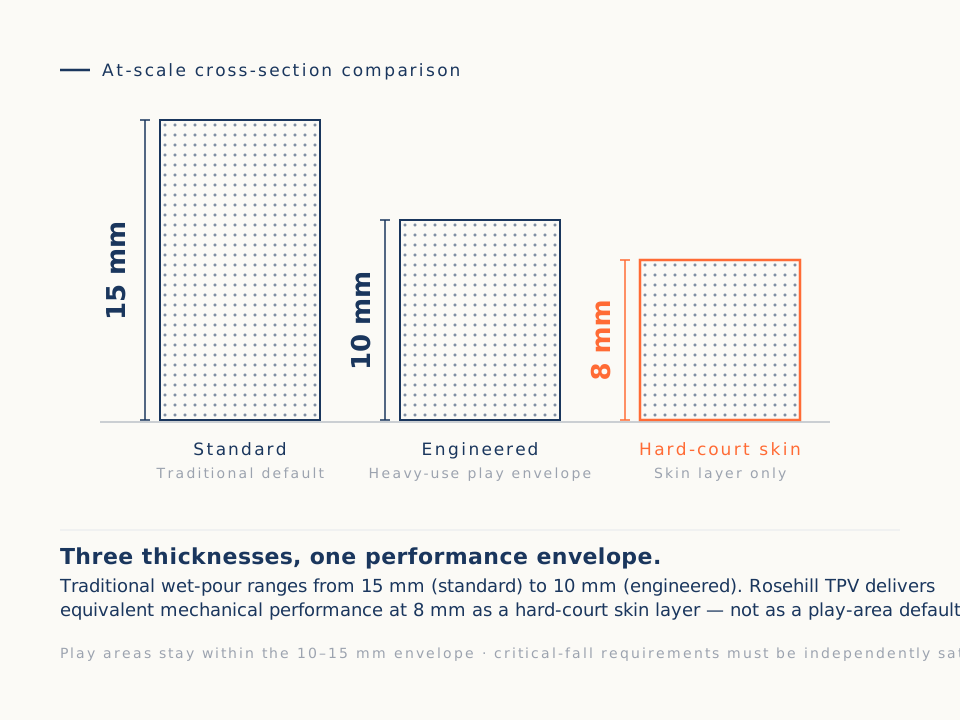
- Thickness follows fall height and loading — by zone, not site-wide. Paying for depth where no equipment stands is money that should have gone into the wear path.
- Granule geometry follows the wear case: denser, finer matrices where loading is concentrated and strength matters most; coarser structures where drainage or texture leads.
- Binder type and ratio follow the material, colours, climate and cure window — a system decision (Josh Jones's article in this chapter covers why more binder is not a design).
- Testing follows the risk: composite performance (EN 12230) and impact attenuation (EN 1177) on the actual build-up for the actual zones — plus wet behaviour where users are barefoot.
- Maintenance expectations follow usage — and belong in the specification, because a surface's year-five condition is a shared responsibility only if the document says so.
At Rosehill we formalise this internally: matching the performance class of the system to the demands of the use, so tensile requirement, geometry, binder ratio and thickness follow from the application rather than from habit. The mechanics of that framework are something we walk through with project teams individually — every scheme's profile is different — but the principle is free to anyone: classify the use first, then let the system follow.
A splashpad, a toddler area, a MUGA and a destination park should not share a specification — however good the granule.
Putting this into practice. Tell us about the application — users, exposure, design life — and we'll help you develop a specification matched to it, without charge. Or book the full Science of Performance CPD for your team. The Application & System Specification Guide accompanies this article.
Clare Riley works on specification support at Rosehill Sports & Play, part of Rosehill Group. She works with architects, landscape architects and local authorities on performance-led surfacing specifications. Every Rosehill TPV® granule is manufactured at Sowerby Bridge, West Yorkshire.